Best Cornea Specialist in Jalandhar
If you’ve been told your eye problem is “nothing serious” by three different doctors but something still feels off — keep reading.
Jalandhar has good eye hospitals. One example is Narang Netralaya. But to find a professional who works specifically with corneal cases, you would need to try more than just going down to the nearest eye hospital with some hope and optimism.
There is some misinformation to clear up here first.
It is true that every cornea specialist is an ophthalmologist. However, in ophthalmology, there are generalists, corneas included. The difference sits in what happens after the main degree — a fellowship. One to two years of training focused almost entirely on the cornea, the ocular surface, corneal surgeries, transplants. It’s not a minor distinction. It’s the difference between someone who recognises a condition and someone who has managed three hundred cases of it.
The cornea itself is surprisingly unforgiving for something so small. Half a millimetre of tissue doing most of the work of focusing your vision. It makes 65-75% of your eyes total focusing power. When something goes wrong on that surface — infection, thinning, scarring — it moves fast. And some of it doesn’t reverse.
A general ophthalmologist seeing ten different types of cases in a day develops broad skills. That’s valuable. But keratoconus picked up early on topography, a fungal ulcer correctly identified before it scars, a dry eye case managed at the root cause instead of with drops forever — that comes from someone whose entire clinical brain is wired around the cornea.
Jalandhar, honestly, doesn’t have many of those. Which is exactly why Narang Netralaya’s cornea team matters.
What Does a Cornea Specialist Treat?
Quite a bit, actually.
Corneal infections are more serious than they sound. Bacterial ones move fast. Fungal ones are slower but harder to treat and easy to misdiagnose. Viral infections — usually herpes simplex — tend to come back. Contact lens wearers in particular need to take these seriously. One bad infection, especially if treated late and with the wrong drops, can leave a permanent scar right in the middle of the visual axis.
Corneal Ulcer. This is an open sore and an ocular emergency. It is very painful and requires a culture and sensitivity for targeted topical treatment instead of a generic broad-spectrum topical antibiotic. It is the role of the specialist to diagnose the underlying cause and treat it.
Keratoconus. This disorder causes the thinning and protrusion of the cornea in a conical fashion. Diagnosis typically occurs in the teenage to early adult years. As the disorder progresses, visual distortion of ghosting, shadowing, and streaking light becomes more prominent. Glasses become less and less effective. The good news is that corneal crosslinking is completely effective at halting the progression of the disorder, but it must be diagnosed in the early stages.
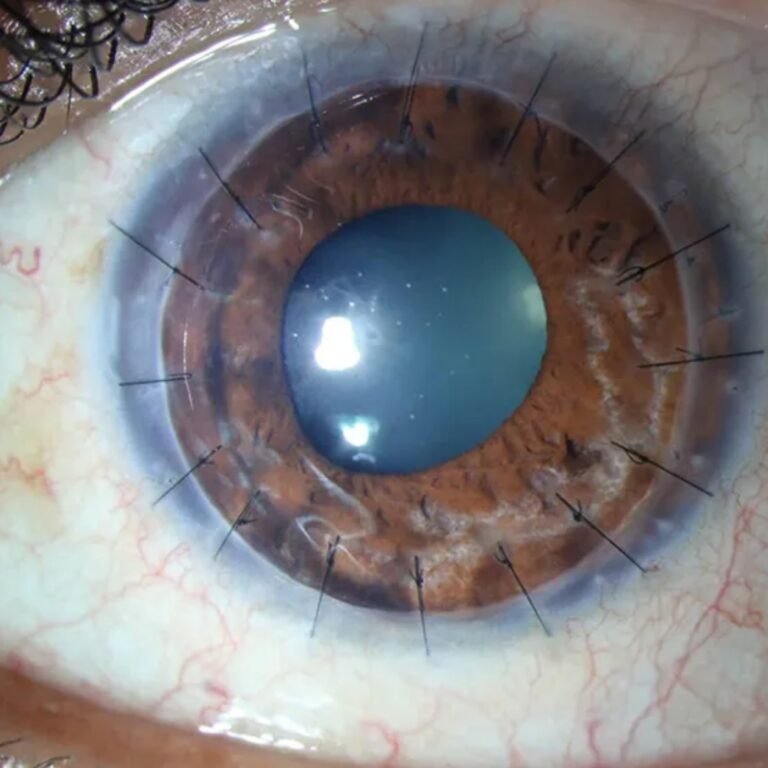
Corneal Scarring. Injuries and infections of the cornea heal with scarring that, depending on location and depth, can significantly affect visual acuity. Scarring of the cornea can be treated with custom contact lenses, but in some cases surgery become necessary.
Dry Eye Disease. Dry eye has a substantial effect on the corneal and conjunctival membranes as a surface disease. In Chronic Dry Eye, the corneal surface becomes inflamed and dry with surface breakdown and even scarring. This can be managed with artificial tears, but restoring and repairing the corneal surface becomes more economically viable with the appropriate underlying diagnosis.
When Should You Visit a Cornea Specialist?
Honestly? Earlier than most people do.
The sequence is usually: something feels off. Wait. General practitioner. Prescriptions for eye drops. Either slight or no improvement. Something feels off again. Repeat. Month 4: realization.
Do not do that.
There are certain warnings to look for. You should go directly to a cornea specialist, for instance, if your contact lenses or glasses aren’t working, or if you keep getting eye infections. From that point, you can determine whether or not you need an additional specialist. If you suddenly can’t tolerate contact lenses you’ve worn for years. If light sensitivity has noticeably increased — especially halos or glare at night. If there’s any redness concentrated around the cornea specifically rather than general eye redness.
And if you can see a white or grey spot on the front of your eye with the naked eye — same day. That is not something to sleep on.
Advanced Cornea Care at Narang Netralaya
Narang Netralaya functions as a full-service eye hospital, not just an outpatient setup. For cornea patients specifically, what that means practically is access to diagnostic equipment that most places in this region simply don’t have.
Corneal topography (PENTACAM) is a very accurate way of mapping the cornea. It is a technique that can be used to detect what is known as early keratoconus or any other corneal ectasia. Keratoconus is a degenerative disease that leads to a progressive thinning and bulging of the cornea. Without topography, a doctor is largely working blind on anything involving corneal shape.
Anterior segment OCT is cross-sectional imaging of the cornea’s layers. Scar depth, corneal thickness, structural assessment before surgery — this is where that data comes from. It removes guesswork from decisions that really shouldn’t involve guesswork.
Specular microscopy looks at the endothelial cell layer — the innermost cells of the cornea that keep it clear. These cells do not regenerate. Losing them is permanent. Before any corneal surgery, and during follow-up care, monitoring these cells isn’t optional. It’s how complications get caught before they become serious.
Treatment at Narang Netralaya is built around what the diagnostics show, not around a fixed menu of options. That matters more than it sounds.
Meet the Cornea Care Team at Narang Netralaya
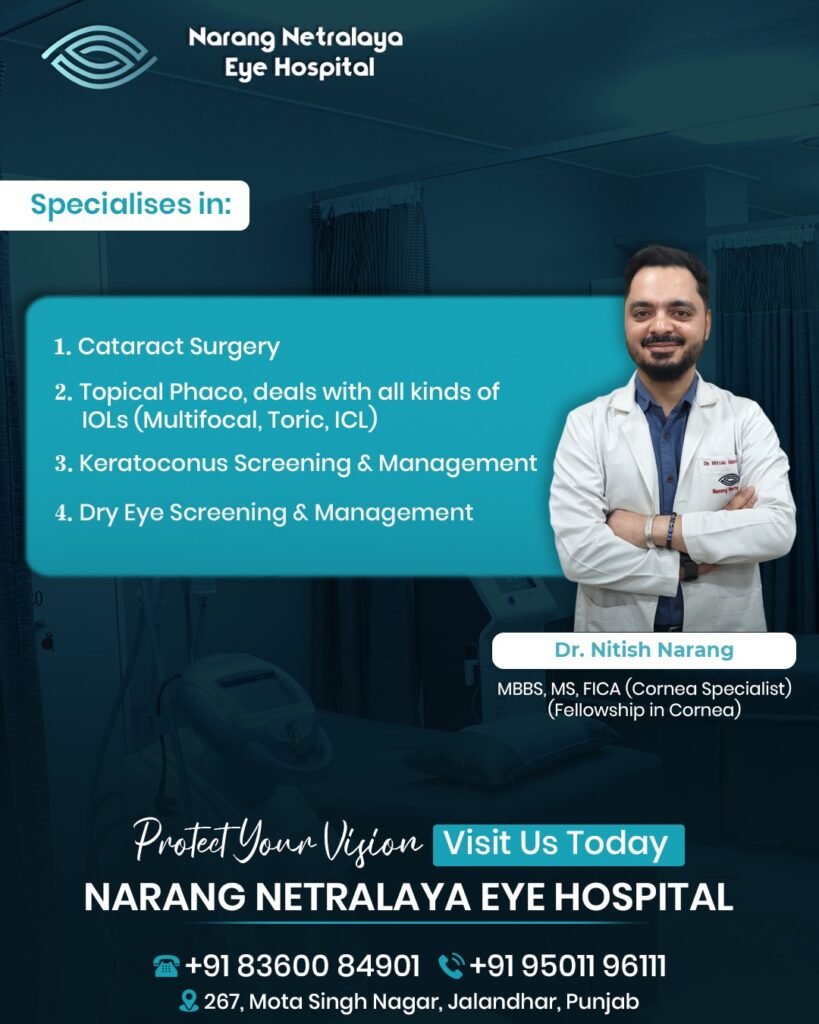
Dr. Nitish Narang is fellowship-trained in cornea. Not just ophthalmology — cornea specifically from Bangalore West Lions Eye Hospital.
That fellowship involved supervised, high-volume exposure to the full range of corneal conditions. Keratoconus management across different stages. Corneal transplants . Ocular surface reconstruction. Complex infections. The kind of caseload that builds the clinical judgment you can’t get from a textbook or a short workshop.
What that means for patients at Narang Netralaya is access to a doctor whose entire specialist training was shaped around the problems they’re coming in with. Someone who has seen a lot of keratoconus cases doesn’t just know what it is — they know how it behaves, how it progresses in different patients, what cross-linking results typically look like at six months, and when to have a harder conversation about surgical options.
For people in Jalandhar dealing with corneal conditions — or who’ve been told their case is too complicated for a general eye hospital — that’s the kind of specialist worth seeing.
Why Patients Choose Narang Netralaya for Cornea Care
A few honest reasons.
There is no concern when you go here to get your eyes checked. You can trust us, as the building has been here long enough. Its reputation in Jalandhar is built around the results we get, and not the pamphlets we hand out.
Everything diagnostic happens in one place. No referral slips, no “go get this test done elsewhere and bring the report.” The topography, the OCT, the specular microscopy — it’s all within the eye hospital. One visit gives you a complete picture.
For More Information Click Here
Frequently Asked Questions
Q1. What is a cornea specialist?
An eye doctor with fellowship training in cornea diseases and surgery. Treats issues from various types of eye infections, dry eyes, and conditions like keratoconus to corneal transplants.
Q2: When should I see a cornea specialist?
Seeing blurriness even with glasses, getting eye infections a lot, suddenly not being able to wear contacts, being more sensitive to light, and getting a white spot in the eye are all symptoms that need a cornea specialist.
Q3:Can corneal diseases cause vision loss?
Yes. Infections that scar the cornea and keratoconus in its late stages can cause vision to become uncorrectable. Corneal scarring can be clear and permanent.
Q4: What is keratoconus?
Has to do with the cornea thinning in a cone shape. Typically occurs in the late teens/early twenties. At varying degrees, can be stopped permanently with corneal cross linking.
Q5: Can corneal infections be treated?
Why yes, if they are of an early enough stage. Treatments vary for infections of different causes, such as bacterial and fungal. The wrong course of treatment can cause prolonged healing and increased scarring of the eye.
Q6: Is cornea treatment painful?
Diagnostic procedures are not invasive. Eye drops may have mild sting. There is a local anaesthetic for the surgical procedures. There may be some discomfort, but it is temporary.
Q7: How do I book an appointment with a cornea specialist in Jalandhar?
Contact Narang Netralaya eye hospital directly to schedule with the cornea team. If symptoms have been going on for a while — don’t wait longer. Earlier appointments consistently lead to better outcomes with corneal conditions.
Opening Hours
Monday
10 AM - 2 PM & 4 PM - 8 PM
Tuesday
10 AM - 2 PM & 4 PM - 8 PM
Wednesday
10 AM - 2 PM & 4 PM - 8 PM
Thursday
10 AM - 2 PM & 4 PM - 8 PM
Friday
10 AM - 2 PM & 4 PM - 8 PM
Saturday
10 AM - 2 PM & 4 PM - 8 PM
Sunday
CLOSED

We dedicated to providing flexible & accessible healthcare services.
Monday
10 AM - 2 PM & 4 PM - 8 PM
Tuesday
10 AM - 2 PM & 4 PM - 8 PM
Wednesday
10 AM - 2 PM & 4 PM - 8 PM
Thursday
10 AM - 2 PM & 4 PM - 8 PM
Friday
10 AM - 2 PM & 4 PM - 8 PM
Saturday
10 AM - 2 PM & 4 PM - 8 PM
Sunday
CLOSED
Narang Netralaya is one of Jalandhar’s most trusted eye care centres, offering advanced treatments with a patient-first approach.
- Visit Our Hospital 267, Mota Singh Nagar, Jalandhar, Punjab
- Contact Us +91 83600 84901
Vision
CATARACT
Retina
CORNEA
PEDIATRIC
GLAUCOMA
ICL
LASER
Vision
CATARACT
Retina
CORNEA
PEDIATRIC
GLAUCOMA
ICL
LASER