Best Pediatric Ophthalmologist in Jalandhar
Seven years old and his teacher thought he was cheating. His parents were mortified. But when someone finally checked his eyes, the picture changed completely — the boy couldn’t see past the second row. Had never been able to. He’d said nothing because blurry was simply normal to him.
Kids don’t walk up and tell you their vision is bad. They don’t have a reference point. They adjust, they cope, they fall behind — and everyone around them blames everything except the eyes.
Kids don’t walk up and tell you their vision is bad. They don’t have a reference point. They adjust, they cope, they fall behind — and everyone around them blames everything except the eyes.
Narang Netralaya has been dealing with exactly these cases in Jalandhar for years. Some children come in at three. Others arrive at ten, after the damage to their vision has had time to settle in.

When Should You Take Your Child to an Eye Specialist?
Here are signs that shouldn’t be ignored:
The child rubs their eyes constantly. Not once in a while — regularly, especially during or after reading or schoolwork. Eyes that are working too hard get tired fast.
One eye seems to turn in or drift outward. It might only happen occasionally, when the child is sleepy or zoning out. Still needs to be checked.
Headaches that show up specifically during reading or homework. Not always. But when a child keeps complaining about head pain that comes during near work, the eyes are often the reason.
Sitting extremely close to the TV, or holding books right against the face. The child isn’t being awkward. They’re doing what they need to do to actually see.
Grades dropping suddenly. A lot of children get referred for ADHD assessments before anyone thinks to check their eyes. Can’t see the board, can’t follow the lesson, starts switching off in class. The report card suffers and the eyes get the blame last.
Tilting or turning the head to look at things. Odd habit, easy to miss. Children do this when the two eyes have significantly different prescriptions, or when a squint makes one viewing angle clearer than another. It’s the body finding a workaround for a problem the child can’t explain.
Don’t wait. With children’s eye conditions, time genuinely matters.
Common Eye Problems in Children
Refractive Errors
Myopia, hyperopia, astigmatism — these are the most common by far. The shape of the eye causes light to focus in the wrong place. Glasses correct it easily enough. The harder part is catching it, because children almost never come and tell you their vision is blurry. Why would they? They don’t know it should be otherwise.
Some children have one eye that wanders. Not always — sometimes only when they’re exhausted or staring into space. Parents often think it comes and goes so it can’t be serious. It can be. Whether the squint is there constantly or just occasionally, it needs a proper look. Obvious or barely noticeable. What matters beyond the appearance is what the brain does in response — it starts ignoring the image from the turned eye to avoid confusion. That ignored eye then falls behind in development.
Lazy Eye (Amblyopia)
The eye itself looks normal. There’s nothing visibly wrong with it. But it doesn’t see well, because the brain checked out of that eye somewhere during development — usually because of an untreated squint or because one eye had a much stronger prescription than the other.
Treatment is patching — the good eye gets covered so the brain is forced to start using the weak one. Works well before age eight or nine. Gets harder after that. This is genuinely one of those conditions where a few years makes the difference between a full recovery and a permanent problem.
Conjunctivitis mostly. Red, sticky, watery eyes that go through schools and households at remarkable speed. Antibiotic drops clear it in most cases.
Watering Eyes
In babies, almost always a blocked tear duct. The channel that drains tears from the eye into the nose gets blocked. Massage usually clears it within the first year. When it doesn’t, a simple procedure opens it up. In older children, constant watering has different causes and needs its own assessment — it’s not the same condition.
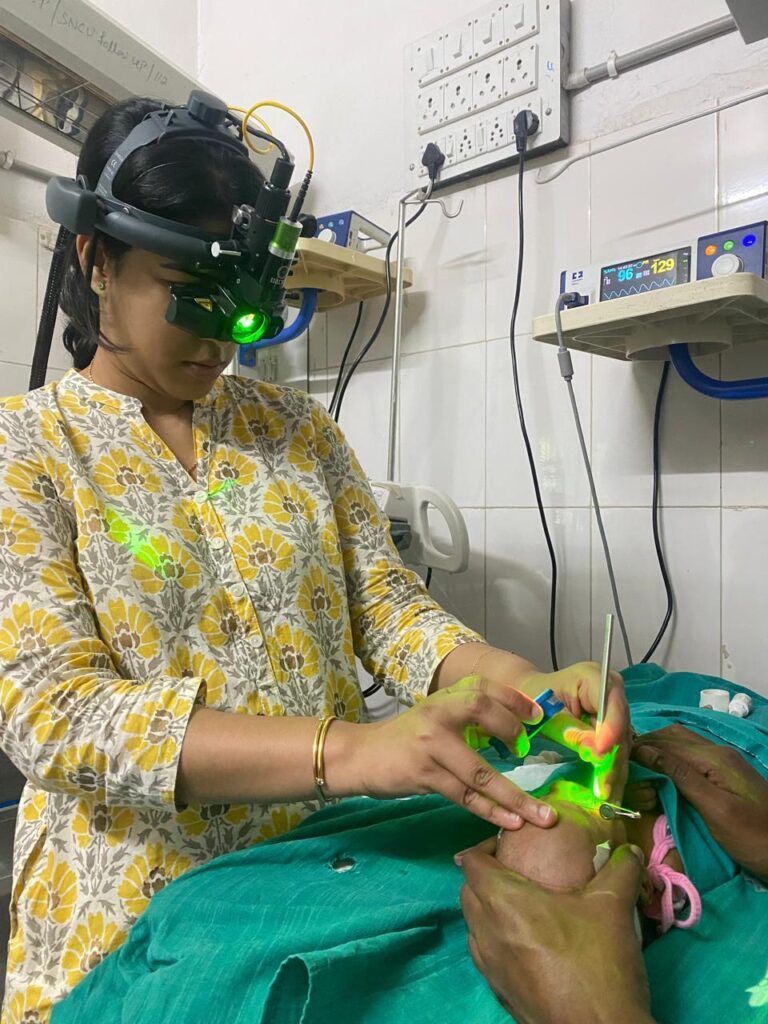
Child Eye Care Services at Narang Netralaya
At Narang Netralaya, younger children are tested using picture charts, objective refraction methods that measure prescription without needing a verbal response, and examination techniques built for children who won’t — or can’t — cooperate the way adults do. Dilated eye drops are used when needed to get an accurate prescription and a proper view of the back of the eye.
For squint cases, the type and degree of the turn is assessed, along with whether amblyopia has already developed. For lazy eye, a patching programme is designed and followed over time with regular checks to make sure the weaker eye is genuinely responding.
Parents are always told what was found and what it means in plain terms — not medical language, just a clear explanation of the problem and what comes next.
Why Parents Choose Narang Netralaya for Pediatric Eye Care
Children settle here. Getting reliable results from a frightened six year old is harder than it sounds. They fidget, they guess, they shut down completely. Half the information you need just doesn’t come through. That’s why how a child feels during the visit matters as much as the equipment being used. The team at Narang Netralaya deals with children regularly. The approach is adjusted accordingly.
How Often Should Children Have Eye Checkups?
More often than most families manage.
First proper examination: around age three. Earlier if there’s family history of squint, high prescription, or amblyopia — or if anything looks off before then. The checks done after birth are basic and pick up only serious structural abnormalities.
After that, once a year through school age is the minimum. Even with no symptoms. Even after passing a school screening. Prescriptions change. Conditions can develop slowly. Annual checks catch problems before they quietly affect a year of school.
Children already in glasses, or with any existing eye condition, often need to come every six months.
School eye screenings catch obvious problems. They miss plenty. Not the same as a proper examination.
Frequently Asked Questions
Q1.Who is the best pediatric ophthalmologist in Jalandhar?
Ask around in Jalandhar about children’s eye care and Narang Netralaya comes up quickly. Families from Phagwara, Hoshiarpur, Kapurthala, Banga, Moga make the trip specifically for this. There are closer options — but for pediatric eye problems, most parents want somewhere that’s handled these cases many times before.
Q2: When should a child have their first eye examination?
Three years old is a good target. But if something looks off before that — one eye turning, constant watering, the child seems to be struggling to focus, looking Tv coming near to it — don’t wait for a birthday. The birth checks hospitals do are basic. They miss a lot.
Q3: What does a pediatric ophthalmologist treat?
The conditions vary a lot. A baby with constant watering. A five year old whose one eye has drifted without anyone noticing. A nine year old whose prescription has been wrong for years. Blocked tear ducts, recurring infections, things children are simply born with. Early or late — they all come through eventually.
Q4: Can squint be corrected in children?
Yes. Some children need nothing more than the right pair of glasses and the squint settles. Others need patching or surgery. What decides the outcome more than anything else is how early the family came in.
Q5: What is lazy eye?
When One eye appears fine physically but doesn’t see well — because at some point during early childhood, the brain quietly stopped using it. Covering the good eye with a patch forces the brain to reconnect with the weaker one. It works. But mostly in children under eight or nine.
Q6: How do I know if my child needs glasses?
Watch how they behave rather than waiting for them to say something — because they usually won’t. Squinting at the TV, dragging a book right up to their nose, complaining of headaches after homework, losing interest in reading. Any of those is worth getting checked.
Q7: How often should children have eye checkups?
Once a year from age three, even with no problems. Every six months if they wear glasses or have a known eye condition. School screenings are not a substitute for a proper examination.
Opening Hours
Monday
10 AM - 2 PM & 4 PM - 8 PM
Tuesday
10 AM - 2 PM & 4 PM - 8 PM
Wednesday
10 AM - 2 PM & 4 PM - 8 PM
Thursday
10 AM - 2 PM & 4 PM - 8 PM
Friday
10 AM - 2 PM & 4 PM - 8 PM
Saturday
10 AM - 2 PM & 4 PM - 8 PM
Sunday
CLOSED

We dedicated to providing flexible & accessible healthcare services.
Monday
10 AM - 2 PM & 4 PM - 8 PM
Tuesday
10 AM - 2 PM & 4 PM - 8 PM
Wednesday
10 AM - 2 PM & 4 PM - 8 PM
Thursday
10 AM - 2 PM & 4 PM - 8 PM
Friday
10 AM - 2 PM & 4 PM - 8 PM
Saturday
10 AM - 2 PM & 4 PM - 8 PM
Sunday
CLOSED
Narang Netralaya is one of Jalandhar’s most trusted eye care centres, offering advanced treatments with a patient-first approach.
- Visit Our Hospital 267, Mota Singh Nagar, Jalandhar, Punjab
- Contact Us +91 83600 84901
Vision
CATARACT
Retina
CORNEA
PEDIATRIC
GLAUCOMA
ICL
LASER
Vision
CATARACT
Retina
CORNEA
PEDIATRIC
GLAUCOMA
ICL
LASER