Eye Flu Treatment in Jalandhar
Eye flu in Jalandhar hits every year without warning. One morning everything is fine. By evening one eye is red, watering, and stuck shut. By the next morning both eyes are involved and half the household is asking if they should be worried.
Most people know what eye flu looks like. Not everyone knows when it needs a doctor and when it will settle on its own.
This page covers both.
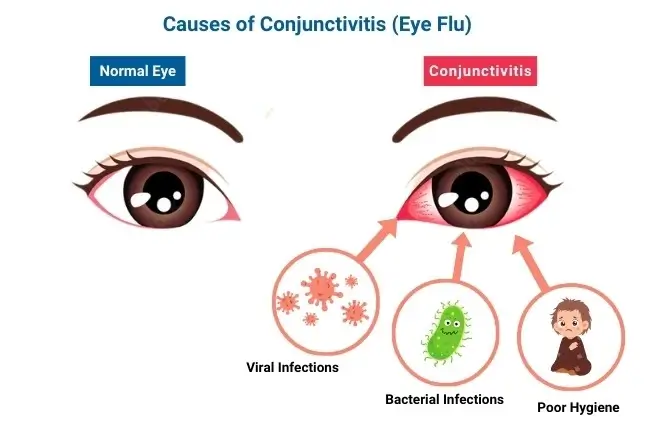
What Is Eye Flu and Why Does It Spread So Fast in Jalandhar?
Eye flu — medically called viral conjunctivitis — is an infection of the conjunctiva, the thin transparent layer covering the white of the eye and the inside of the eyelids. A virus gets in, the immune system reacts, and the result is redness, watering, discharge, and that uncomfortable gritty feeling like something is permanently stuck in the eye.
Jalandhar sees eye flu outbreaks every year — particularly during monsoon season and in the weeks immediately after. Humidity creates the perfect environment for the virus to survive outside the body. Schools, offices, public transport, shared washrooms — the virus moves fast when people are in close contact. One infected person in a classroom can spread it to multiple others within days.
The most common culprit is adenovirus. Highly contagious. Spreads through direct contact with infected discharge, touching contaminated surfaces and then touching your eye, or occasionally through water — swimming pools during outbreak season being a particular risk.
Symptoms of Eye Flu — What to Look For
Eye flu does not usually hit both eyes at once. It starts in one — redness, watering, that stuck-shut feeling in the morning — and within a day or two the second eye follows. By the time both are involved most patients in Jalandhar are already wondering whether they should have come in sooner.
Redness is usually the first thing noticed — not a small patch but a diffuse pink or red across the entire white of the eye. Watering follows quickly, often significant enough to run down the cheek. Discharge builds up overnight — patients describe waking up with eyes stuck shut and needing warm water to open them.
What eye flu generally does not cause — significant pain deep inside the eye, sudden vision loss, or a coloured halo around lights. If any of those are present alongside the red eye, that is not straightforward eye flu and needs urgent assessment at Narang Netralaya Eye Hospital Jalandhar the same day.
Is Eye Flu an Emergency?
Eye flu treatment in Jalandhar is needed urgently in specific situations — not every case.
Uncomplicated viral conjunctivitis resolves on its own in 7 to 14 days in most cases. The body clears the virus. Symptoms reduce gradually. No permanent damage occurs.
But come in the same day if any of these are present — vision that is blurring and not clearing when you blink, significant pain rather than just discomfort and grittiness, a cornea that looks hazy or cloudy rather than clear, symptoms that are getting worse after day 5 instead of improving, or a newborn or very young infant with red sticky eyes.
Bacterial conjunctivitis — a different infection that sometimes gets confused with viral eye flu — needs antibiotic eye drops and does not resolve on its own. And occasionally what looks like eye flu is actually something more serious — uveitis, acute angle closure glaucoma — conditions where delayed treatment causes real damage.
When in doubt, come in. Narang Netralaya Eye Hospital Jalandhar — +91 83600 84901.
Causes and Risk Factors for Eye Flu in Jalandhar
Eye flu spreads differently depending on the season and setting — and Jalandhar has specific patterns worth knowing.
School-age children are the most commonly affected group — and the most reliable spreaders. A child with eye flu at school on Monday means siblings and parents are often symptomatic by Wednesday. School outbreaks in Jalandhar during peak season can affect entire classrooms within days.
Swimming pool exposure during the warmer months carries its own risk. Chlorine levels that are not properly maintained allow adenovirus to survive in the water. Shared towels, shared pillows, shared eye makeup — all transmission routes that are completely avoidable.
Contact lens wearers face higher risk than glasses wearers. The lens sits directly on the conjunctiva. During any eye flu outbreak in Jalandhar, contact lenses should come out immediately at the first sign of redness and not go back in until symptoms have fully cleared.
How to Stop Eye Flu Spreading in Your Home
Eye flu prevention in Jalandhar during outbreak season starts at home — and the measures that actually work are simpler than most people expect.
Wash hands every time you touch your eye or face. Not a quick rinse — proper hand washing for twenty seconds. The virus lives on hands and surfaces for hours.
Separate everything that touches the face. Towel, pillow cover, glasses — all separate from other family members for the duration of symptoms. Change the pillow cover daily.
Stop touching your eyes. Easier said than done but genuinely the most important step. The virus gets in through the eye — usually from contaminated hands.
Stay home from work or school while actively symptomatic and contagious — typically the first 5 to 7 days. Eye flu spreading through an office in Jalandhar during peak season is not inevitable — it just requires one infected person going in and touching shared surfaces.
Cold water splashed gently over closed eyes provides temporary relief. Do not splash water directly into the open eye — it does not help and risks introducing other contaminants.
Why Patients Visit Narang Netralaya for Eye Flu in Jalandhar
Eye flu consultation in Jalandhar at Narang Netralaya means getting an accurate diagnosis before treatment begins — not guessing whether it is viral, bacterial, or something else entirely.
Dr. Nitish Narang examines the eye properly under slit lamp magnification. Discharge characteristics, corneal clarity, follicle pattern on the inner eyelid surface, presence of any membrane formation — all of these details determine exactly what is happening and what is needed. A two-minute look and a prescription written without examination is not that.
Eye Flu Treatment at Narang Netralaya Jalandhar
Eye flu consultation in Jalandhar at Narang Netralaya means getting an accurate diagnosis before treatment begins — not guessing whether it is viral, bacterial, or something else entirely.
Dr. Nitish Narang examines the eye properly under slit lamp magnification. Discharge characteristics, corneal clarity, follicle pattern on the inner eyelid surface, presence of any membrane formation — all of these details determine exactly what is happening and what is needed. A two-minute look and a prescription written without examination is not that.
Frequently Asked Questions
Q1. How long does eye flu last?
Seven to fourteen days is the typical run for viral conjunctivitis. First three or four days are the worst — discharge heavy, eyes stuck shut in the morning, light sensitivity annoying. After that it starts easing off. If day five arrives and things are getting worse rather than better, that needs a proper look at Narang Netralaya Jalandhar.
Q2: Is eye flu contagious?
Extremely. Touch your eye, touch a door handle, someone else touches that handle and then their eye — done. Shared towels and pillowcases are probably the most common route inside households. Separate everything that touches your face and wash your hands far more than feels necessary.
Q3: Can eye flu damage vision permanently?
Simple viral conjunctivitis — no. The eye recovers completely. The problem is when the cornea gets involved. Some strains leave small cloudy deposits on the cornea that blur vision and can hang around for months. Catching that early at Narang Netralaya means it gets managed before it becomes a longer problem.
Q4: Can I wear contact lenses during eye flu?
Take them out the moment redness appears. Do not put them back until everything has fully settled — at minimum two weeks after symptoms clear. Wearing lenses during active infection puts the cornea at unnecessary risk.
Q5 Should I use antibiotic drops for eye flu?
Only if a doctor confirms it is bacterial — not viral. Antibiotics do nothing against a virus. Half the patients who come into Narang Netralaya Jalandhar with persistent red eyes have already used two or three antibiotic drops bought over the counter. No improvement, because it was viral from the start.
Q6 When should I see a doctor for eye flu in Jalandhar?
Come in the same day if vision is actually blurring, if there is real pain rather than just grittiness, if the cornea looks hazy, if a newborn has red sticky eyes, or if things are getting worse after five days instead of better. For mild cases with no red flags — home management is reasonable for the first couple of days. Narang Netralaya Eye Hospital Jalandhar — +91 83600 84901.
Opening Hours

We dedicated to providing flexible & accessible healthcare services.
Narang Netralaya is one of Jalandhar’s most trusted eye care centres, offering advanced treatments with a patient-first approach.
- Visit Our Hospital 267, Mota Singh Nagar, Jalandhar, Punjab
- Contact Us +91 83600 84901