Diabetic Retinopathy Treatment in Jalandhar
Here is something most diabetic patients in Jalandhar do not know. Their eyes are probably being damaged right now. Not maybe. Not possibly. If blood sugar has been running high for years — the retina is taking a hit. Silently. Without any pain. Without any obvious warning.
Imagine the back of your eye is a wall covered in a thin sensitive film. That film — the retina — is what actually sees. Light hits it, it sends signals to the brain, your brain makes sense of the world. Simple enough.
Now imagine that film has a water supply problem. Tiny blood vessels feed it constantly. When blood sugar stays high for months or years, those vessels start to leak. Some bleed. Some grow in wrong places. The film gets waterlogged, scarred, and eventually stops working the way it should.
That is diabetic retinopathy. Not complicated. Just slow, quiet, and if ignored long enough — permanent.
Who Gets It?
Technically anyone with diabetes can develop it. But some people are sitting with much higher risk than they realise.
Length of time with diabetes is probably the biggest factor. Someone fifteen years into the condition has had fifteen years of those small vessels under pressure. Someone diagnosed recently has time on their side — but only if they start annual retina checkups now.
Blood sugar control changes everything. People who keep their HbA1c in a reasonable range develop retinal problems far more slowly than those who do not. Not perfect control — just consistent.
Then there is blood pressure and cholesterol. Both add stress to vessels already struggling. Both accelerate the timeline.
Symptoms — and Why They Are a Problem
Floaters suddenly appearing. Blurred vision that comes and goes. A dark patch somewhere in your field of sight. Colours looking washed out. Trouble seeing clearly at night. Sudden loss of vision in one eye with no explanation.
These are the things patients describe when they finally come in.
The problem is none of these appear early. Floaters do not appear out of nowhere. When they show up, the retina has quietly been under attack for months — sometimes longer. Same with blurred vision. By the time it becomes noticeable enough to bother someone, the window for the simplest treatment has usually already passed.
This is not unique to one or two patients. It is the pattern seen again and again at Narang Netralaya — people who felt completely fine, came in for an unrelated reason, and discovered retinal changes they had no idea existed.
How We Check the Retina
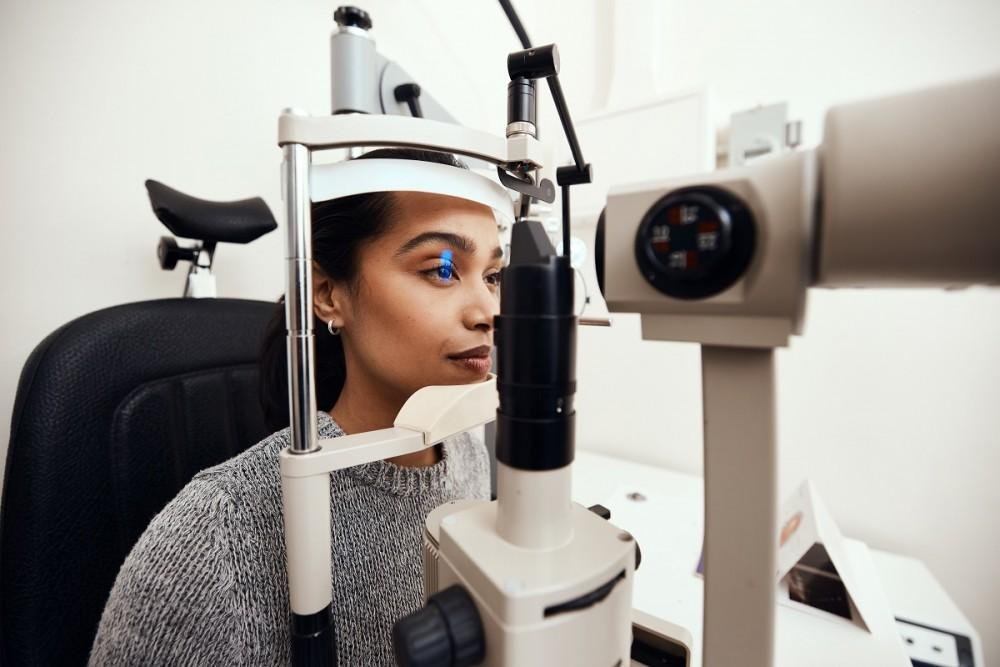
A dilated eye examination comes first. Drops widen the pupil and the retina gets examined directly. This takes a few minutes and remains the most important part of any diabetic eye assessment. No machine replaces it.
After that, an OCT scan — Optical Coherence Tomography — gives a cross-section of the retinal layers. Fluid building up under the retina, swelling, early structural changes — the OCT shows all of this before symptoms appear. Before the patient suspects anything is wrong.
Fundus imaging then photographs the retina at high resolution. That photograph becomes a baseline. Every follow-up visit, the new image is compared to the old one. Changes are tracked. Tiny new bleeds get noticed. Vessel abnormalities get caught.
Between these three — dilated exam, OCT, fundus imaging — very little gets missed.
What Treatment Looks Like
For active disease, intravitreal injections are usually the starting point. A fine needle delivers medication into the back of the eye. It sounds worse than it is — most patients are surprised by how quick and manageable the procedure feels. The injections reduce fluid leakage and slow abnormal vessel growth. Typically a series is needed over several months, with the frequency reducing as the retina settles.
Retinal laser deals with specific leaking vessels and abnormal growth areas. It does not recover lost vision. What it does is significantly reduce the chance of things getting worse. Done in the clinic, no anaesthesia required beyond drops, no admission.
When things have progressed further — significant bleeding into the vitreous, scar tissue forming, the retina starting to pull away — vitreoretinal surgery becomes necessary. This is a procedure Dr. Madhushmita Narang performs at Narang Netralaya. Patients in Jalandhar and across Doaba no longer need to travel to Hyderabad or Chandigarh for this level of care. It is available here.
For patients with early or no retinopathy, regular monitoring is the plan. Knowing exactly where things stand is itself a form of management.
The Thing About Timing
Vision lost to advanced diabetic retinopathy does not come back. The retina does not repair itself once seriously damaged. No treatment reverses what is already gone.
What treatment does — and does very well when started early — is stop the progression. Keep what is there. Protect the vision that remains.
Early disease needs monitoring, maybe nothing else. Moderate disease responds very well to injections and laser. Advanced disease needs surgery, takes longer, and the results are less predictable.
The difference between these scenarios is almost always just one thing. When the patient first came in.
Annual retina screening for every diabetic patient is not optional. Not a suggestion. It is the only reliable way to catch this before it catches you.
Narang Netralaya for Diabetic Retina Care
Dr. Madhushmita Narang did her Fellowship in Vitreo-Retina Surgery at LV Prasad Eye Institute in Hyderabad. LVPEI trains some of the best retinal surgeons in Asia — it is not a routine fellowship. She is also a Gold Medalist in MS Ophthalmology and Punjab State Topper. She has personally performed over 600 vitreoretinal procedures.
Everything diagnostic — OCT, fundus imaging, dilated examination — happens in-house at Narang Netralaya. No external referrals for scans. No sending patients across the city for investigations.
Treatment plans here are not standard packages. They are built around the individual — how long they have had diabetes, what their current sugar control looks like, exactly what the retina shows at that visit.
Frequently Asked Questions
Q1. Can diabetic retinopathy be cured?
It cannot be reversed. But caught early, it can absolutely be controlled. Most patients who come in before significant damage has occurred maintain good vision long-term.
Q2: Can diabetes actually cause blindness?
Yes. Advanced diabetic retinopathy causes blindness. It also causes it slowly enough that most patients never see it coming — which is the entire argument for annual retinal checkups.
Q3:How often should diabetic patients get eyes checked?
Once a year. Every year. Even when vision feels perfectly fine. Especially when vision feels perfectly fine.
Q4: What are the first signs of diabetic retinopathy?
Early diabetic retinopathy has no calling card. No pain, no blurring, nothing that makes a person think something is wrong. The floaters and dark spots people describe — those come later, after the disease has already done significant work. A yearly retinal scan is the only way to get ahead of it.
Q5: Is laser treatment for the retina painful?
Most patients feel very little. Anaesthetic drops are used beforehand. The procedure takes minutes. No admission, no recovery time — patients go home the same day.
Q6: When should a diabetic patient see a retina specialist?
New floaters, a sudden blur, a dark patch that was not there before — none of these should wait in a diabetic patient. Call Narang Netralaya Eye Hospital Jalandhar the same day. Not tomorrow. The number is +91 83600 84901.
Opening Hours

We dedicated to providing flexible & accessible healthcare services.
Narang Netralaya is one of Jalandhar’s most trusted eye care centres, offering advanced treatments with a patient-first approach.
- Visit Our Hospital 267, Mota Singh Nagar, Jalandhar, Punjab
- Contact Us +91 83600 84901