Best Cataract Surgeon in Jalandhar
Cataract surgery changed my father’s life. That’s something we hear from patients’ families almost every week. An elderly parent who stopped reading, stopped watching television, stopped recognising faces across the room — and then, in 1-2 days after surgery, is able to recognise family members clearly!
We’ve been doing this in Jalandhar since 2019. Enough time that few of our patients have got their maternal and paternal parents till now. That kind of relationship with a city and its families is not something you manufacture. It accumulates slowly, through how you treat people when they’re scared and when they’re vulnerable.
Cataract surgery is not complicated when done properly. The procedure itself is eight to ten minutes. It’s a day care procedure, patients go home on the same day. Vision improves within 24 to 48 hours for the majority of people. But “done properly” is doing a lot of work in that sentence — it means the right diagnostic workup beforehand, the right lens selected for that particular person’s eye and lifestyle, a surgeon who has done this enough times that the unexpected doesn’t become a crisis, and proper follow-up after.
People visit here from Hoshiarpur, Nawanshahr, Phagwara, Banga, Kapurthala . Some have told us they visited two or three hospitals before deciding. We never take that trust lightly.
If you’ve been noticing your vision getting hazier, colours looking duller, headlights at night becoming uncomfortable — come in. Sometimes it is a cataract. Sometimes it’s something else entirely. Either way, you need to know.
Who Is the Best Cataract Surgeon in Jalandhar?
We’re obviously not the most objective source on this question.
What we can say is what to actually look for. A surgeon’s qualifications are a starting point, not the full answer. Two surgeons can have identical degrees and wildly different levels of practical skill. Volume matters in surgery — someone doing one thousand cataract procedures a year is different from someone doing hundred, even if both are trained. Ask.
Experience with difficult cases matters more than people expect. The reason is not that your case will necessarily be complicated — most cataracts are routine. But a surgeon who has only ever handled straightforward cases has never had to make a difficult intraoperative decision. A surgeon who has managed mature cataracts, post-traumatic presentations, patients with weak zonules, polar cataracts, IFIS, small pupils— that experience changes how they handle everything, including routine cases. It makes them calmer, more prepared, better at anticipating.
At Narang Netralaya, our team has that range of experience. We get referrals from other facilities when cases are complicated. That’s not us boasting — it’s just a description of what happens.
The pre-operative process here is thorough. Optical biometry for IOL power calculation. Corneal evaluation. A proper look at the retina before any decision about surgery is made. The IOL selection conversation is real — not “this is what we use” but “here are your options, here’s the difference, here’s what I’d recommend for you specifically and why.”
The best surgeon is one you trust after meeting them. Come for a consultation. Form your own opinion.
Why Choose Narang Netralaya for Cataract Surgery?
There’s a version of this answer that lists facilities and equipment and sounds like a brochure. We’ll try to give you a more honest version.
We’ve been in Jalandhar long enough to have built a reputation that either holds up or doesn’t when patients ask around. We think it holds up. Patients come back for other eye conditions after their cataract surgery. They bring family members. We have elderly patients whose adult children have now started their own treatment here. That pattern tells you something.
The surgical infrastructure matters too though, so we won’t skip it entirely. We use Phacoemulsification — micro-incision surgery that requires no stitches and allows recovery within days rather than weeks. Our IOL calculation uses optical biometry, not older manual methods. The operation theatre is maintained to proper sterilisation standards. These details matter for safety outcomes and most patients never think to ask about them.
On lenses — we offer the real range. Standard monofocal lenses that work well and cost less. Multifocal/ Trifocal lenses for patients who want to read and drive without glasses after surgery. Toric lenses for patients with astigmatism that isn’t corrected by standard IOLs. Each option require immense training and expertise for implantation and do have genuine trade-offs, which we explain our patients properly. If a premium lens isn’t the right choice for your eye or your life, we’ll say so.
Post-operative follow-up is structured and our team is accessible if something comes up between appointments. That matters more than most people realise until they actually need it.
Meet Our Experienced Cataract Surgeons
Our cataract surgeons trained in ophthalmology with a specific focus on anterior segment surgery. They’ve been operating since 2013. More than credentials, they’ve developed the kind of surgical judgment that comes only from working through difficult cases — complicated cataracts, patients with co-existing conditions like glaucoma or corneal disease, cases that required adjusting approach mid-procedure.
Patients tell us the consultations here feel different from some other places they’d visited. Not rushed. The surgeon actually reads the pre-operative reports rather than glancing at them. Questions get answered with some depth rather than reassurances designed to move you through the schedule faster.
We see referred cases — eyes that other facilities sent to us because the presentation was complex or the surgeon there wasn’t confident handling it. Mature white cataracts with poor visibility. Post-traumatic cases with structural irregularities. These cases require experience that only comes from years of consistent surgical practice. IOL implantation is done in capsular bag and in traumatic eyes bag is not there or misplaced (bag dialysis) in such situations normal IOL can’t be implanted, our expert surgeon is trained to implant Scleral Fixated IOLs in such cases to give good results. Our expert surgeon has been doing surgery under topical anaesthesia (without giving injection) since 2017 in all cataract surgeries, a which honed after years of practice.
The surgeons update their knowledge regularly. Not just conferences — actual application of new techniques and IOL designs as the evidence develops. What was standard practice in cataract surgery ten years ago is not what we do today, and staying current matters for patient outcomes in ways that are real and measurable.
How Do I Choose a Cataract Surgeon?
Ask them how many cataract surgeries they’ve personally performed. Not the hospital’s total — theirs. A surgeon who has done 20,000 cases is different from one who has done 200, regardless of how long either has been practising.
Then — and this one matters — ask them what happens if something goes wrong during surgery. Not if it will, but what happens when it does. How do they handle a posterior capsule tear? Do they know how to place an IOL in the sulcus if the bag isn’t available? Do they know when to stop and refer? A surgeon who’s never faced this situation hasn’t done enough surgery. A surgeon who has faced it and handled it well — that’s who you want.
The pre-op process tells you a lot. If you’re being scheduled for surgery after a ten-minute assessment with no biometry, no dilated exam, no real conversation — walk out. I don’t mean that dramatically. I mean it practically. Proper cataract preparation takes time. The corneal measurements, the IOL calculation, and the retinal check — these determine whether your surgery is successful in ways that can’t be fixed afterwards.
On lenses — this is where I see a lot of patients get misled, not necessarily dishonestly, just through oversimplification. “Premium lens better than standard” is not actually how it works. A multifocal lens in the wrong eye, or for the wrong person, produces a result the patient hates — halos, glare, difficulty in dim light. I’ve seen patients who had premium lenses placed elsewhere come to me unhappy, not because the surgery failed, but because nobody properly assessed whether they were good candidates for that lens type.
Visit the surgeon in person before deciding. The consultation itself tells you everything — whether they listened, whether they answered your questions or redirected them, whether you felt like a person or a booking.
Is Cataract Surgery Safe?
Yes, with some important context.
Phacoemulsification — the technique we use — involves a wound under 2.2mm, no sutures, and typically takes five to ten minutes. Globally, it’s considered one of the most successful elective procedures in medicine. Serious complication rates are genuinely low when done in appropriate facilities by experienced surgeons.
The “when” in that last sentence is doing real work. The same procedure carries different risk profiles depending on where it’s done and by whom. A well-equipped, well-run facility with an experienced surgeon is not the same as one that isn’t — even if both are described as offering “Phaco surgery.” Sterilisation standards, instrument quality, IOL calculation accuracy, intraoperative decision-making — all of these affect outcomes.
One thing I always tell patients before they leave my OPD — because it catches people off guard if they don’t know about it — is something called posterior capsule opacification. PCO. It has nothing to do with the surgery going wrong. What happens is this: months later, sometimes two years later, sometimes five, the thin membrane sitting behind the artificial lens starts to get hazy. The patient notices their vision is getting cloudy again. They come back to me convinced the cataract has returned. I understand why they think that — it feels exactly the same. But the lens I removed is gone. That’s not what’s happening.
PCO is seen more in hydrophilic lenses (the cheap option available in IOLs) than in hydrophobic IOLs, it is so routine for me at this point that I almost don’t stress about it in consultations anymore — not because it doesn’t matter, but because the fix is so simple. I do a YAG laser right here in my clinic. The patient sits at the machine, laser shots are fired for a minute , no injection, no cut, nothing. They go home. By evening most of them are messaging saying their vision is sharp. It’s not a complication in the scary sense. It’s just a follow-up procedure that some patients need and some don’t.
Frequently Asked Questions
Q1. What is the cost of cataract surgery in Jalandhar at Narang Netralaya?
Cost varies by lens choice. Standard monofocal lens surgery is priced at a level accessible to most patients. Premium lenses — multifocal, toric — cost more because of the optical engineering involved and the post-surgical benefit of reduced dependence on glasses. We give you the full cost breakdown at the consultation stage, specific to your eye and the lens that makes sense for you. Nothing is added later without your knowledge. If cost is a concern, say so — there are usually options.
Q2: How long does recovery take after cataract surgery?
Honestly, faster than most people expect. The morning after surgery — Day 1 follow-up, patients are usually already seeing better than they were before. Not perfect yet, the eye is still settling, but noticeably better. On next follow-up after 1 week, patients regains 95% vision. One of my patients, a retired school principal from Model Town, told me she cried at her Day 1 visit because she could see my face clearly for the first time in what felt like years. That kind of moment happens more often than you’d think.
The full picture though — complete stabilisation, final clarity — takes around four to six weeks. The eye is still adjusting to the new lens during that time. The drops I prescribe need to be taken properly through this whole period, even on the days the eye feels totally normal. I’ve had patients stop their drops at week two because everything felt fine, and a few of them came back with inflammation that set them back. It’s not worth the shortcut. Reading, TV, phone — fine within a couple of days. Rubbing the eye and swimming — absolutely not for two weeks. Heavy lifting or intense physical work — three to four weeks minimum, I’m firm on that one.
Q3: How long does the surgery itself take?
My routine cases — a standard age-related cataract in a reasonably healthy eye — I’m usually done in five to ten minutes, sometimes a little under. A dense brunescent cataract, or a case with a complicating factor may take longer. I don’t have a fixed time I’m trying to hit. The eye takes as long as the eye needs.
What I tell patients to plan for is two to three hours at Narang Netralaya on surgery day. Most of that time is not the surgery — it’s the preparation beforehand, the anaesthesia settling, and then a rest period after where my team monitors you before I check the eye and say you can go home. You leave the same day. And — this is a question I get asked a lot — no, I don’t do both eyes on the same day. Ever. The second eye gets done after I’ve seen the first one heal well, usually on first week follow up visit.
Q4: What exactly is Phaco surgery? How is it different from the old method?
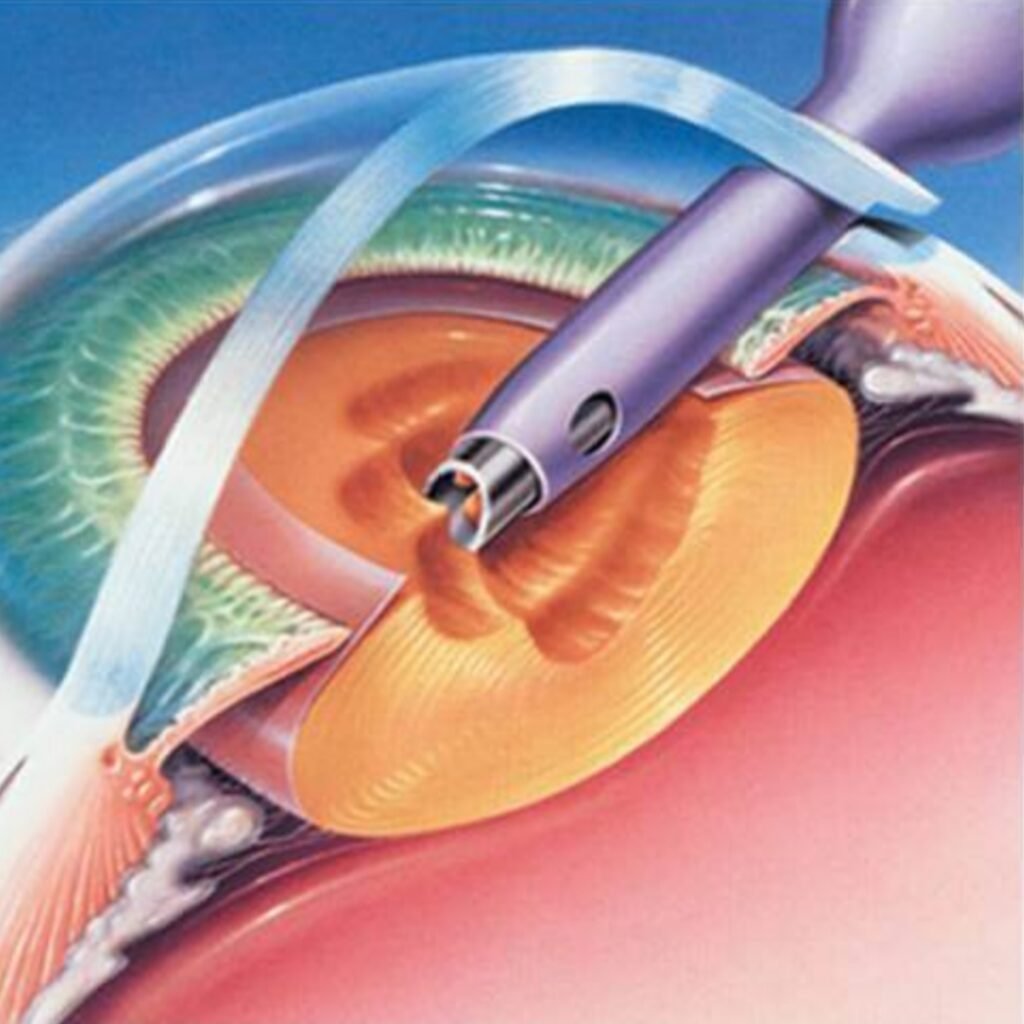
Phaco is short for Phacoemulsification. The way I explain it to patients in my OPD is this: imagine the clouded lens inside your eye like a hardened lump. I make a cut smaller than 2.2mm — smaller than you’d expect, genuinely tiny — and I insert a probe that uses ultrasound vibrations to break that lump into very small fragments. Those fragments get suctioned out. Then I fold up the artificial lens — the IOL — like a scroll inside a syringe like injector, pass it through the same small opening, and it unfolds inside the eye and settles into position. No stitches. The wound closes on its own.
The old technique, ECCE, needed a cut of maybe 10 to 12mm. Sutures. Patients were told to lie carefully for weeks, not lift anything, come back multiple times to have stitches removed. I trained on both methods. There is genuinely no comparison — Phaco is faster, safer, heals better, and gets patients back to their lives within days. It’s been the standard globally for a long time now and it’s the only technique I use for routine cases at Narang Netralaya. I have been doing topical Phaco (surgery under anaesthesia effect of drops not requiring injection) since 2017, a skill which I honed after thousands of surgeries, give even a faster recovery with patients going home with goggles without bandage on eyes and a smile on their face .
Opening Hours

We dedicated to providing flexible & accessible healthcare services.
Narang Netralaya is one of Jalandhar’s most trusted eye care centres, offering advanced treatments with a patient-first approach.
- Visit Our Hospital 267, Mota Singh Nagar, Jalandhar, Punjab
- Contact Us +91 83600 84901