Eye care for children in Jalandhar
Eye care for children in Jalandhar is something most parents think about only after a problem has already shown up.
Your child moved the phone closer to their face again. Third time this week. Or the teacher mentioned they seem distracted in class. Or you noticed them squinting at something across the room — and when you asked, they had no idea they were doing it.
Kids don’t tell you their vision is blurry. To them it isn’t blurry. It’s just the world. That’s the problem. And by the time someone catches it, months or years have sometimes already passed.
The visual system is not fully developed at birth. It develops gradually through childhood, reaching maturity somewhere between ages 7 and 9. During this window, the brain is actively learning to see — building connections between the eyes and the visual cortex.
If something interferes with that process — an uncorrected refractive error, a squint, a drooping eyelid, a congenital cataract — the brain simply stops developing the connection to the affected eye. It is not a decision. It just happens. The eye looks normal. The child feels no pain. But the vision in that eye quietly falls behind and eventually the brain stops using it properly.
This is called amblyopia. Lazy eye. And it is the most common cause of permanent vision loss in children — not injury, not disease, just an untreated problem during the developmental window.
After age 9, that window closes. Treatment becomes harder. Recovery becomes less complete. Some improvement is possible in older children but nothing close to what is achievable at age 4 or 5.
This is why the first eye examination should happen by age 3. Not when the child starts school. Not when the teacher complains. Age 3.
Common Eye Problems in Children We Treat at Narang Netralaya
*Refractive Errors — Myopia, Hyperopia, Astigmatism*
Short-sightedness is probably the most common thing picked up at children’s eye exams in Jalandhar right now. It is getting more common every year — screens play a role, time spent indoors plays a role, and genetics plays a big role. A child who cannot see the classroom board clearly does not raise their hand and say so. They copy what their neighbour writes. They get labelled slow or distracted. The actual problem is sitting on their face and nobody has checked yet.
Long-sightedness and cylindrical power cause different problems — headaches after reading, avoiding close work, tiring quickly during homework. All of it fixable with the right glasses prescription.
*Amblyopia — Lazy Eye*
Glasses come first. If glasses alone do not bring the lazy eye up to speed, patching the stronger eye forces the brain to start using the weaker one. Sometimes atropine drops are used instead of a patch — same principle, different method. It takes months. Consistency matters more than anything else. Dr. Nitish Narang reviews progress at every follow-up at Narang Netralaya and adjusts the plan based on how the eye is responding — not a fixed protocol applied to every child.
*Squint — Strabismus*
One eye points straight. The other turns in, out, up, or down. Sometimes constantly. Sometimes only when the child is tired or concentrating hard.
Parents often hope the child will grow out of it. Occasionally that happens with very young infants. After 6 months, a squint that persists needs assessment. Left untreated, it causes amblyopia in the turned eye. Treated early — glasses first, patching if needed, surgery in selected cases — outcomes are significantly better.
*Congenital Cataract*
A cloudy lens present from birth. Rare but serious. The eye cannot develop properly if light is not reaching the retina clearly from the very beginning. Congenital cataract is treated surgically, often in the first weeks or months of life, followed by glasses and patching to rehabilitate the visual system.
*ROP — Retinopathy of Prematurity*
Premature babies face a specific retinal risk that most parents have never heard of. Babies born before 34 weeks or weighing under 1750 grams at birth need retinal screening — because abnormal blood vessel growth in the immature retina can cause blindness if not caught and treated in time.
Dr. Madhushmita Narang completed specific ROP screening training at LV Prasad Eye Institute in Hyderabad. For families in Jalandhar whose baby was born early — that means the assessment happens here. Not a referral to Chandigarh. Not a two hour drive with a newborn. Here, at Narang Netralaya, by a doctor who was trained specifically for this at one of the best retinal institutes in Asia.
*Blocked Tear Ducts in Newborns*
Many newborns have a watery or sticky eye from birth. Usually this is a blocked nasolacrimal duct — the channel that drains tears from the eye to the nose. In most cases it resolves on its own within the first year with gentle massage. When it does not, a simple procedure opens the duct. Narang Netralaya assesses and manages this from infancy.
How Children's Eye Examinations Work at Narang Netralaya
Children are not small adults. Examining their eyes requires different techniques, different equipment settings, and a different approach entirely.
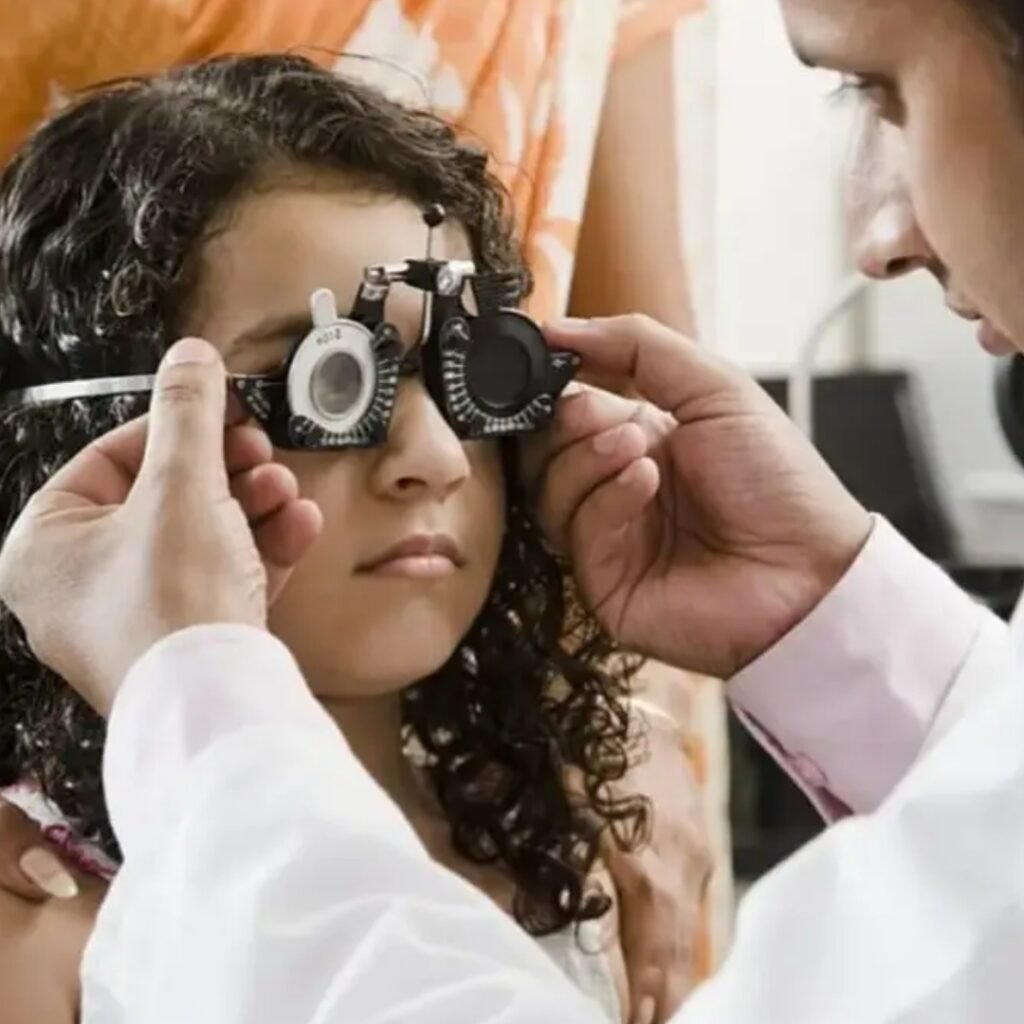
Young children cannot read a letter chart. They cannot reliably say which lens is clearer. They get distracted, uncooperative, or simply scared. A paediatric eye examination at Narang Netralaya uses age-appropriate vision tests — picture charts, LED targets, retinoscopy — that give accurate results without requiring the child to cooperate perfectly.
Dilating drops are used when needed to get an accurate refraction — especially important in children where the focusing muscles can mask the true prescription. This takes about 45 minutes for the drops to work, during which children can sit in the waiting area.
The full examination covers visual acuity in each eye separately, eye alignment assessment, refraction under dilation, anterior segment examination, and dilated retinal examination when indicated.
Warning Signs Parents in Jalandhar Should Not Ignore
These are the things that should prompt an eye examination — not a wait-and-see approach:
One eye turning inward or outward, even occasionally. Head tilting or turning to look at things. Sitting unusually close to the television. Holding books or phones very close to the face. Frequent eye rubbing, especially in one eye. Complaints of headaches after reading or screen time. A white reflex visible in one eye in photographs — this is a red flag that needs same-day assessment. Drooping of one eyelid.
None of these are reasons to panic. All of them are reasons to come in.
Spectacles for Children — Common Questions
Parents worry about putting glasses on young children. Will they wear them? Will glasses make the eyes worse? Will the child need glasses forever?
Glasses do not make eyes worse. They correct what is already there. A child whose myopia progresses while wearing glasses would have progressed faster without them. The glasses are not the cause — the underlying eye development is.
Why Families in Jalandhar Choose Narang Netralaya for Their Children's Eyes
Both doctors at Narang Netralaya have specific training relevant to paediatric eye conditions. Dr. Nitish Narang manages refractive errors, amblyopia, squint, and anterior segment conditions in children. Dr. Madhushmita Narang handles ROP screening and paediatric retinal conditions — with fellowship training from LV Prasad Eye Institute specifically in retinal disease management including ROP.
All diagnostic equipment is in-house. No sending families to external labs. No multiple trips across Jalandhar before a diagnosis is confirmed.
Frequently Asked Questions
Q1. At what age should my child have their first eye examination?
Age 3 is the general answer. Earlier if anything looks off — an eye turning, constant rubbing, or a white glow visible in photos instead of the normal red eye effect. Premature babies need retinal screening much earlier than that, sometimes within weeks of birth.
Q2: My child passed the school screening — is a proper exam still needed?
School screenings catch the obvious cases. They miss plenty — mild lazy eye, early squint, colour vision problems, and anything that needs a dilated examination to find. Passing a school screen is not the same as having a full eye exam at Narang Netralaya Jalandhar.
Q3: Can lazy eye still be treated in older children?
Yes but the results get less predictable the older the child gets. A six year old responds faster and more completely than a ten year old. A ten year old still benefits more than a fourteen year old. The point is — whenever you find out, start. Waiting another year while hoping for improvement on its own does not help.
What I tell patients to plan for is two to three hours at Narang Netralaya on surgery day. Most of that time is not the surgery — it’s the preparation beforehand, the anaesthesia settling, and then a rest period after where my team monitors you before I check the eye and say you can go home. You leave the same day. And — this is a question I get asked a lot — no, I don’t do both eyes on the same day. Ever. The second eye gets done after I’ve seen the first one heal well, usually on first week follow up visit.
Q4: Will my child need glasses their whole life?
Myopia usually increases through the school years and tends to slow down and stabilise somewhere in the late teens. Some prescriptions reduce with age. Some stay. The glasses prescription gets checked every six to twelve months at Narang Netralaya and updated when needed.
The old technique, ECCE, needed a cut of maybe 10 to 12mm. Sutures. Patients were told to lie carefully for weeks, not lift anything, come back multiple times to have stitches removed. I trained on both methods. There is genuinely no comparison — Phaco is faster, safer, heals better, and gets patients back to their lives within days. It’s been the standard globally for a long time now and it’s the only technique I use for routine cases at Narang Netralaya. I have been doing topical Phaco (surgery under anaesthesia effect of drops not requiring injection) since 2017, a skill which I honed after thousands of surgeries, give even a faster recovery with patients going home with goggles without bandage on eyes and a smile on their face .
Q5: Is squint surgery safe for young children?
Yes. It is done under general anaesthesia so the child feels nothing. Most kids are back to their normal routine within a week. The goal is getting the eyes aligned early enough that the brain does not permanently shut off the turned eye — and that goal is very achievable when surgery happens at the right time.
The old technique, ECCE, needed a cut of maybe 10 to 12mm. Sutures. Patients were told to lie carefully for weeks, not lift anything, come back multiple times to have stitches removed. I trained on both methods. There is genuinely no comparison — Phaco is faster, safer, heals better, and gets patients back to their lives within days. It’s been the standard globally for a long time now and it’s the only technique I use for routine cases at Narang Netralaya. I have been doing topical Phaco (surgery under anaesthesia effect of drops not requiring injection) since 2017, a skill which I honed after thousands of surgeries, give even a faster recovery with patients going home with goggles without bandage on eyes and a smile on their face .
Q6: How do I book an appointment at Narang Netralaya Jalandhar?
+91 83600 84901 — call or WhatsApp. Address is 267 Mota Singh Nagar, Jalandhar. Monday to Saturday, 10 AM to 8 PM. No referral letter needed. Just come in.
Opening Hours
We dedicated to providing flexible & accessible healthcare services.
Narang Netralaya is one of Jalandhar’s most trusted eye care centres, offering advanced treatments with a patient-first approach.
- Visit Our Hospital 267, Mota Singh Nagar, Jalandhar, Punjab
- Contact Us +91 83600 84901